QUICK THOUGHTS ON MAYAKOVSKY
(AND MODERN RUSSIAN POETRY—MARKOV, SPARKS—1967)
J. Arthur Boyle
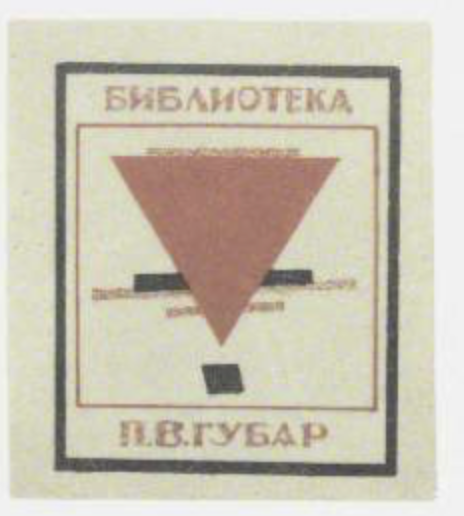
Ex Libris for P.V. Gubar – Il'ia Chashnik
I feel like I still haven't met Vladimir Mayakovsky, largely because of typical translation problems, especially amplified in poetry, especially amplified in his. E.g., it's incredibly difficult to preserve unities of sound sense and meaning across languages, almost impossible if combined with attempts to preserve rhythm, and language conventions (say around rhyme or repetition) vary not just between periods, but across cultures. Specific cultural references may have unclear correlates, or none at all.
Mayakovsky emerged from a pre-revolutionary morass of poetic avant-gardes, and his most enduring sensibility combines a Zaumish commitment to prerational language and image with the braggy masculine negation-of-all-that-came-before inaugurated by Italian futurism. The semi-manifesto for the Russian Futurists, "A Slap in the Face of Public Taste,"
"order[s] that the poets' rights be revered:
- To enlarge the scope of the poet’s vocabulary with arbitrary and derivative words. (Word-novelty)
- To feel an insurmountable hatred for the language existing before their time.
- To push with horror off their proud brow the Wreath of cheap fame that You have made from bathhouse switches.
- To stand on the rock of the word “we” amidst the sea of boos and outrage."
Baller. And yet obviously these are tendencies that aggravate the aforementioned problems. Across the very few translations available online, like the Poetry Foundation, or unloved pdfs from Iowa, or dare I even say Amazon samples, you can feel how stilted some of these translations are, trying to keep pace with V.M.'s incessant neologizing and constantly changing metre while still trying to preserve a shred of meaning and/or rhyme. Sometimes the translations feature nouveau interpretations of antiquated slangs that already sound outdated (like it'd be pretty cool if Mayakovsky actually said "hepcat," but that's lost resonance for everyone), or even worse, they attempt to era-match Americanisms like "pa-tooey." Save us. Free Vladimir.
But amidst all that––these traps of always inadequate translation schemes and the probably consequent dearth of Mayakovsky titles––there are moments where you have A Cloud in Trousers in front of you and say God damn this Slav is ripping. Come off it Vlad:
"We'll paint Monday and Tuesday with blood;
and make them holidays.""I turn
my back, using the sun
as a monocle"[maybe: "I turn
my back,
use the sun
as a monocle" ?]"I nail myself
to every tear""I've cauterized once
tender souls""then I'll
rip out my soul,
stomp on it
to make it big
and hand it to you bloody,
for a flag"[and something like:
in the noise of factories and laboratories
brasslipped Zarathustras preach
on everything before me
I stamp nihil,
thrumming with rhyme,
the tongueless street's in torture;
charred images of numbers and words
rush from my skull
as children from a flaming slum
I'm jumping, I'm jumping, I'm jumping, I'm jumping
They fell in.
You can't jump out of your head
You Cambric-prim bureaucrats of angelic leagues
O mother! Your son is wonderfully ill!
And is the sky turning Judas ever yet again,
a handful of treachery-stained stars
they've chopped up the stars
the sky's dripping blood
Give them
in their mildewed joy
a time of fast death,so the children will grow,
boys becoming fathers
girls––pregnant
let the newborn
have the keen grizzle of the magi
perhaps I'm merely the thirteenth apostle
in a common gospel getting wine
on the soul and tablecloth
for my cheeks to collapse,
stale crusts of old touch,
athlete after fat athlete gleaming by in carriages
stuffed down to the bone,
people cracked open and
the grease dripping out
the dynasty that rules
from a madman's heart
the pastures of the street a jungle
their hands around my throat
the damp mountain of sweat-bellied women
rig a carrousel around the Tree of Good and Evil
I give joy to the road with my own heart's blood]
One thing that’s immediately striking, though maybe less so in this magpied version I've made, is how much Marinnetti is present, how the arrogance and self-assertion of Italian futurism finds itself consistent in Moscow. I don't know how much Marinnetti he'd read, but the modernist, Nietzchean tearing is at times 1-to-1.
That aesthetic makes a stark departure in the post-revolutionary period. Post-1917, and perhaps especially under the aesthetically-classical-thus-Futurist-disapproving eye of Lenin, Mayakovsky purged much of his surrealist bent, as well as the outsized ego, mostly in an attempt to be of better service to the new proletarian project. A pity for the poetry, most often.
But consider a few words on the pre-/post- divide from a book of Mayakovsky I eventually found, an old anthology titled Modern Russian Poetry from 1967[1]:
Traditional division of the twentieth-century poetry into pre-Revolutionary and Soviet is both inconvenient and distorting. The Revolution of 1917 was a historical event, and in literature it chiefly affected thematic material as well as the destinies of individual writers, but it did not create a new system of poetics. Most poets of post-Revolutionary times had their starting point and formative years before the Revolution, but even those whose debut happened to be after the historic events built on a pre-Revolutionary foundation, be it symbolist, Acmeist or futurist (or even pre-twentieth century).
Now, if the anthology's editor Markov was a little more woke to historical dialectics he might concede the turbulence that birthed five or six or maybe seven new poetic -isms could be the same turbulence birthing revolution, and that these aesthetic intensities channeled artistically what the Bolsheviks channeled socially. Revolution too is an act of poiesis, and the dash between poet-revolutionary may be thinner than we think.
But Markov's sentiments are useful and gratifying in multiple directions. In our 21st century, our dead postmodernisms, "experimentalisms," and various other theoryless, directionless avant-gardes, leave artists with a wealth of aesthetic richness: styles, methods, even institutions committed to innovation. But subject is not so much discussed. Subject is individually determined, by which I mean it roughly hews to whatever topics are already popular, which is in turn determined by columnists, marketers, and the state department.[2]
Mayakovsky took his intensities and aimed them at the Revolution. He read in the streets and the streets went nuts because he spoke directly to their moment, directly to them, which is everyone or nearly, and he wrote in an urgently modernist style at the same caliber of those many other names in the canons we've already received. He created and extended the era's aesthetic intensity, but it was incomplete until transformed by historical task: giving real expression to the world's unfolding. It would feel, in many ways, the exact task that much contemporary literature evades: failing adequate expression by enforced adherence to the stale, the outmoded, even the formerly ingenious; failing meaningful representation by its blindness to the wreckage of paradigms, the magnitude of increasingly acute world-historical struggles; failing itself as artistic output by refusing the primary work of the day––failing to take up its subject in life.
Although this a touch convenient, and glosses over sadnesses that come next in Mayakovsky's style––utility's side of the equation. And it leaves much unsaid about our commitments in life as the real basis for art. But this is The Amenia Free Review's moderately sized review! One bite at a time.
-
[1] Kind of an interesting artifact: ok translations, though at least a few inexcusable rhymes, but maybe the first big attempt post-Stalin to gather a brocade of modern Russian poets in English, most of them then-unknown to the rest of the world.
[2] For more than cheek, see Juliana Spahr's Du Bois' Telegram, Dan Sinykin's Big Fiction, and/or Frances Stonor Saunders' The Cultural Cold War, though the latter I must cop to half-finishing b/c it's replete with unenlightening detail. Also not to be missed is Benjamen Walker's podcast Not All Propaganda is Art, that details the CIA’s involvement in shaping mid-century literature and ideology across continents, most notably the intentional career assassination of Richard Wright. (The podcast format allows convenient lapses in legality around what various estates can or cannot allow to be "published.")