THE CARO COMPLEX
Adin Dobkin
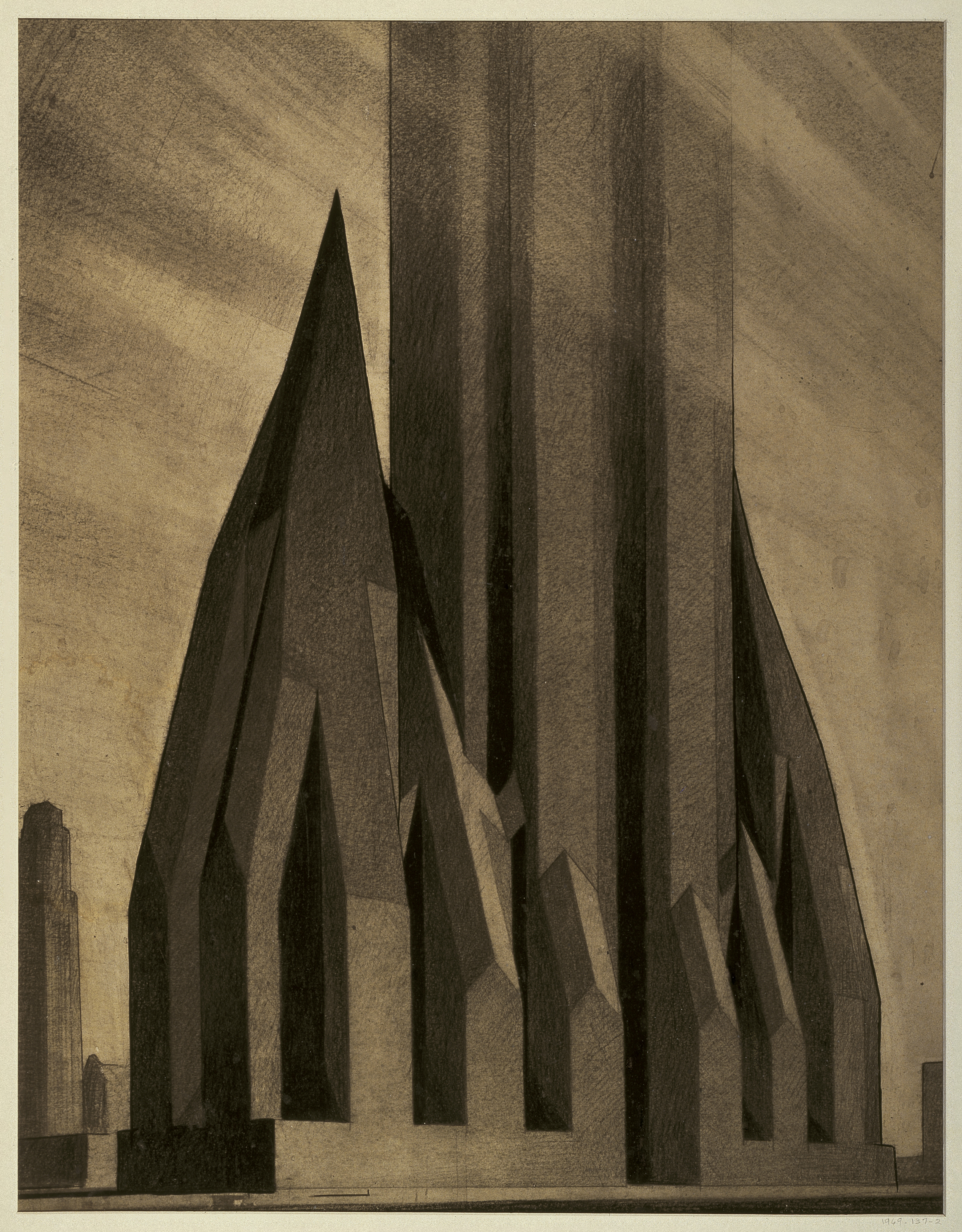
Study for Maximum Mass Permitted by the 1916 New York Zoning Law, Stage 2, by Hugh Ferriss
"Turn Every Page": Inside the Robert A. Caro Archive, an exhibition at the New York Historical
In a Smithsonian profile published last March, Robert Caro—the author of The Power Broker and the soon-to-be five-volumed The Years of Lyndon Johnson—described his process of selecting the New York Historical as a home for his personal papers, an ongoing delivery that has resulted in the exhibition “‘Turn Every Page’: Inside the Robert Caro Archive.”
“A lot of places were bidding, and they were going to elevate me to a different economic class,” Caro told the writer. Then, the Historical entered the picture with an offer that included public space for a selection of his papers, to exist in perpetuity. Even if fire spalls the museum’s foundation stones, Caro, per his contract, is “to have the same number of square feet in an equally prominent place” in whatever structure follows.[1]
For now, visitors to the Upper West Side museum can pass through a second-floor corridor and look at encased items from Caro’s life and literary output. Here, a calendar Caro used to keep track of his progress on The Power Broker. One week: “11 Easter 0 | 12 1,000 | 13 (lazy) 400 | 14 (lazy) 200 | 15 1,400 | 16 0 | 17 (at ___).” Passers-by feel each admonition as if it were borne in blood. After all, when Caro signed his first contract with Simon & Schuster in 1966, the publisher offered him $5,000 for his future efforts, half of which was payable at the start. To dedicate himself to his debut work, Caro left his investigative job at Newsday and his wife, Ina, sold their Long Island Home.[2]
A certain rhyme, then, in Caro’s act of creation and his preferences for a work's reception: a forgoing of the lucrative in the pursuit of the enduring. At the same time, those familiar with Caro, even those who may not have read him, know of his works’ length and rigor. Not a tension, but something unfamiliar—how does he do it? Not many writers I know would sell their homes for a manuscript, nor enlist their spouses as researchers. Of course, most writers I know don’t own homes or have partners waiting at their beck and call.
I don’t fault Caro for availing himself of these opportunities. Even if I don’t exactly admire the asceticism, many or most contemporary books suffer from a lack of conviction in subject and delivery. A bit of pallor I place at writers’ feet, plus quite a bit more at editors’ and publishers’, which cannot be separated from a writer’s subsequent ability to dedicate time to their work (especially in nonfiction works, which are often sold in their early stages of development and which carry additional costs of time and research).
This, I hasten to add, isn’t a review of Caro’s life or texts. I don’t even know that it’s a review of a museum exhibit. Mostly, I’m interested in Caro’s writerly readership, who have fetishized his process, and his political readership, who have fetishized this process as a subject, which to me appear intimately tied. “Turn Every Page” is a manifestation of the former if not the latter, as is Caro’s only essay collection, Working, and even, to a large degree, the other Turn Every Page: a documentary on Caro’s relationship with his longtime editor, Robert Gottlieb.
I promise I’m not trying to be a crank. The existence of these secondary works, the attention paid to a worthy writer whose sort is in worse than short supply, isn’t a bad thing. But alone it expresses a limited literacy, too little concerned with “those on whom [power] is wielded,” as Caro himself described.[3]
The anthropologist finds an exquisite data point in the X account @CaroOnRoomRater. For those who don't watch cable news, a brief introduction. During the COVID-19 pandemic, a politician or journalist called into a news show from a room in their home. Claude Taylor, a member of the Democratic #Resistance, took a screenshot of the room, provided a few pointed critiques of the guest's setup, and a rating (see: “Good art. Nice space. Lighting challenge. Significant cord violations. 7/10 @RepAdamSmith”). @CaroOnRoomRater scoured these screenshots for instances of Caro’s books on the guests' shelves.
Scrolling through the account’s feed, one finds a murderer’s row. Here, Brett McGurk, just before his blood-curdling cannonball into the Biden administration, sitting in front of a book that describes Robert Moses’s preference for automobiles over people. There, candidate Eric Adams, with his boosting of stop and frisk policies, and just behind him, an account of the human cost of Moses’s highways: the extirpation of neighborhoods along race and class-based lines.[4] The Power Broker at Palantir’s Investor Day presentation, even!
These are cynical, and perhaps not totally literate, at least in any historical sense, actors. But neither can I give a pass to the journalists on @CaroOnRoomRater, more beltway insiders than I care to name, who burp up procedural dreck at an astonishing rate, who I’m sure tell themselves that by describing each trip made by the Deputy Assistant Secretary of Defense for Arctic and Global Resilience, they too are telling the story of “those on whom [power] is wielded.”
What these readers share is an unconcern with the tangle of effects a reader encounters in Caro's works. They’re not even bothered, on some level, with the acts of their subjects. Rather, these are individuals interested in how one gains and wields power.
Each editorial memo, interview note, and outline that comprises “Turn Every Page” reminds me of this fact. The exhibit’s ephemera, for that’s exactly what it is, will survive the collapse brought on by them. Caro’s pages will go into orbit with the Historical if they must. For those left here on earth, they can perhaps visit the museum’s ruins. There, in the weathered giftshop, the straggler will find a few sturdier objects for those dire times: ceramic mugs above long-decayed pages, printed with I FINISHED THE POWER BROKER. I suppose that’s endurance of a form.
-
[1] I can’t help but note the Historical sits about 87 feet above the New York waterline, so it should safely weather all but the most catastrophically nautical futures.
[2] According to the Federal Reserve Bank of Minneapolis, this sum equals $48,439 at the time of this essay’s drafting.
[3] There are some similarities here in the treatment of Joan Didion as a character who looms larger than her writing. Perhaps my pose is that our present illiteracy breeds a lionizing of writers at the same time it breeds poor readings of their texts.
[4] It’s no coincidence these political readers haven’t been known for maintaining transparent lines with the press.
Adin Dobkin is a writer and teacher in Brooklyn, NY. He is the author of Sprinting Through No Man's Land and These Bones Can Speak (forthcoming). Adin is a co-editor of the Amenia Free Review.