30 YEARS FOR HOLDING ZINES
Joe Hall
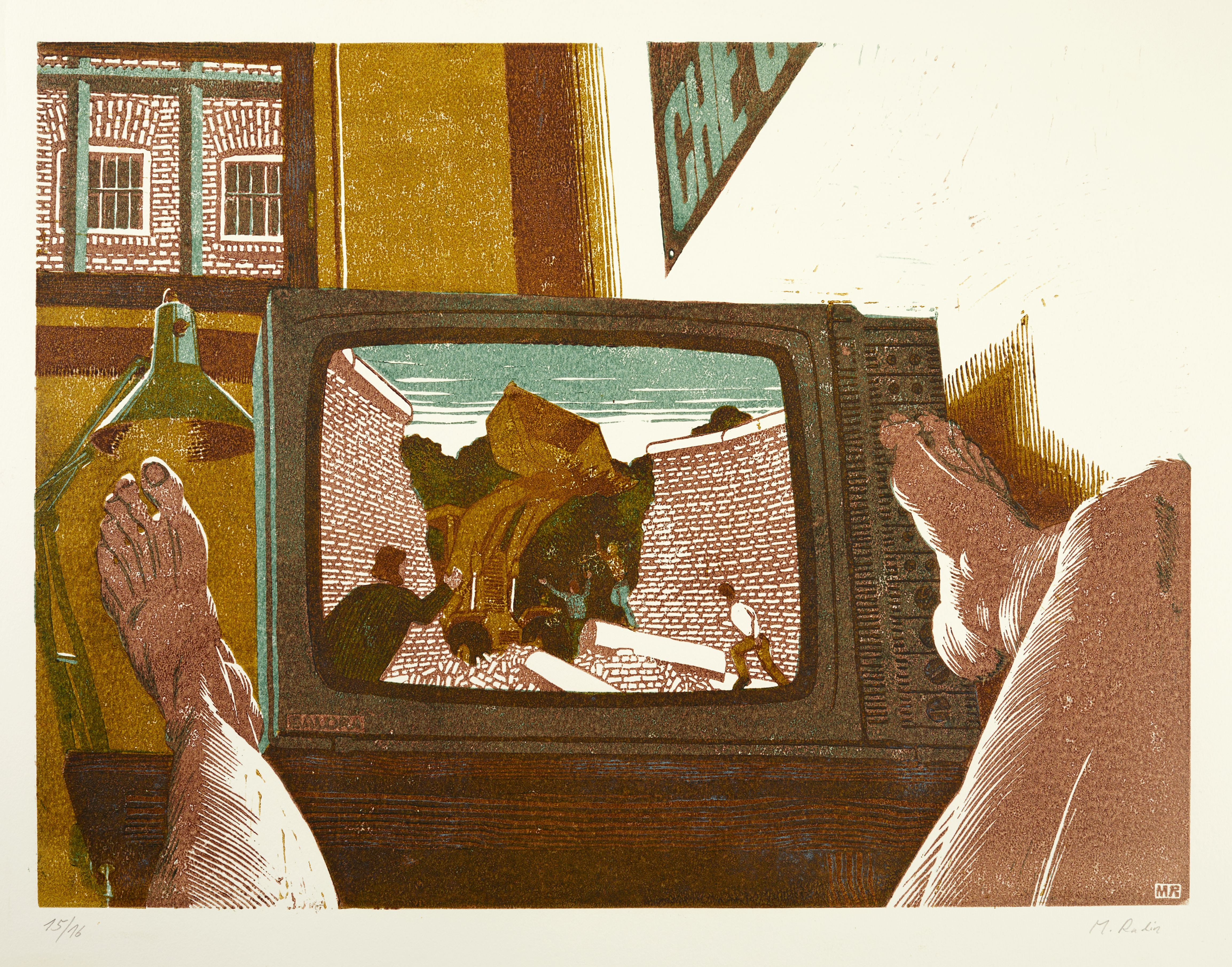
Prison TV –– Marc Rudin
-Lucan, Civil War
Your partner says they’re going to a noise demo outside of an ICE facility. Hours pass. Your phone buzzes. It’s them. They’ve been arrested. Could you move some zines out of the house? You do that. Then you ask a friend if they want the zines. Zines: words on copy paper, folded.
You are arrested, sent to federal prison, and sit in your cell for months before you are convicted of ‘corruptly concealing a document or record and conspiracy to conceal documents.’ You’re sentenced, finally: 30 years.1
That’s what happened to Daniel “Des Revol” Sanchez Estrada, one of The Prairieland 19.
Let’s shade in the picture.
On July 4, 2025, 11 people launched a noise demo outside the Prairieland Detention Center (concentration camp) in Alvarado, Texas.2 Their principal aim was to shoot off fireworks, making enough noise to let the incarcerated know that the outside world stood with them. According to the Prairieland Defendants, a cop arrived, “drew his firearm and aimed it at an unarmed protester while they ran away.” During the altercation, one of the protestors fired a shot, and the armed officer sustained a minor injury. The 11 people attempted to flee. Most of them were arrested that night.
At the heart of the night was a single chaotic moment, when that single protestor, Benjamin “Champagne” Song, acted in defense of the loosely organized and panicked crowd, confronting the cop’s gun and the decades of precedent telling him officers don’t hesitate to shoot at fleeing protestors. In Song’s own words:
I never want to see anyone get hurt. I never want to see good people, standing up for what they believe in, gunned down in the street. What we all saw happen to Renee Good and Alex Pretti is my worst nightmare.
So, when I was standing in the street on July 4th, 2025, in plain view with reflective safety strips and high visibility clothing, what I saw right in front of my eyes was my worst nightmare.
When I saw Lieutenant Thomas Gross stop pursuing and point his gun at the back of a running, unarmed protester, like he testified, I was terrified. As a firearms instructor and a United States Marine Corps veteran, I understood what I was seeing. I knew what it meant for someone to lean forward into a gun, like he testified, to prepare for recoil.
As the evidence shows, I did not want to hurt anyone. I never had the intent to hurt anyone. I tried my best to avoid hurting anyone. It is impossible to say that I was trying to ambush anyone or planning any violence. I was shocked, and surprised, and saddened. I am so grateful for what didn’t happen. I am so grateful that we are not here mourning another death and tragedy. Another Alex Pretti. Another Renee Good. Another Botham Jean. Another Manuel Teran. Another Atatiana Jefferson. Another Philando Castile.3
But the blood of a pig is an alchemical substance, and the prosecution used it to alter that reality. They framed the noise demo as an organized ambush. A bunch of loosely organized people connected by an LGBTQ+ affinity group and a “big left chat”4 became “terrorists” of an “Antifa Cell.”5 Fireworks on the 4th of July became “explosive charges,” and zines became “material support for terrorism.”
The state used this prosecution to test and consolidate its capacity to hang brutal federal charges, including terrorist enhancements, on people engaged in ordinary and constitutionally protected protest activities. The right-wing media seized upon the incident as proof of their gaudy, useful delusions that the broad and ongoing opposition to their fascist attacks is the result of a tightly organized, terroristic organization called—scare quotes—Antifa. Another hallucinatory bogeyman in a line of them: communists, welfare queens, Buffalo Bill-style trans bathroom serial killers.
There was a chance the jury would use common sense to reject the guilty-by-association logic at play, but both judge and prosecution launched byzantine maneuvers to set their case on favorable terms. For the first time in his career, the judge declared a mistrial, dissolving a jury sympathetic to the defense, because the defense's lawyer wore an MLK graphic tee. In the words of Lauren Fadiman, the replacement jury “found almost every defendant guilty on almost every count.”6
In July 2026, sentences came down. One hundred years for Song. 70, 50, and 30 years for seven others, charged with non-violent offenses. If these sentences hold, they will consume the entirety of these individuals’ lives. The sentences defy belief, but display the insecurity of the state and the nakedness of its violence: a radicalized judiciary taking absurd pains to protect the most life- and rights-violating wing of the state as it conducts its racial pogroms.
Most stories present the Prairieland 19 as a test case for the right’s intensifying assault on any forms of protest against their rule, congealing disparate signifiers into an AI-slop-stitched Antifa villain upon which to stick newly widened terror charges.
We see the assault's continuity in Minneapolis, with federal charges leveled against members of Direct Action Minnesota and Black Cat Worker’s Collective, for resisting the migrant pogrom “Operation Metro Surge.” Again, the prosecutors and the expanded pig-class described these as organized “Antifa” groups7. The inclusion of people possessing political literature in these roundups might also bring to mind the RICO case against Stop Cop City organizers, some of whom were heavily charged for distributing know-your-rights zines.8
All of this is part of the feds’ drive to criminalize producing, reading, or having literature they consider subversive. As legal analysts have observed, given the way that literature (as any manifestation of culture) is used to cohere community, its criminalization is a way to destroy said communities. Sending people to prison stops a community from talking to itself, and from drawing in people with similar values.
Cumulatively, these stories of convictions can provoke dread and chill organizing. If one thinks zines are terrorism and Signal chats can be used as a thread toward federal terrorism indictments and hard time, then one might go all Faraday bag, in-person tiny cell organizing, or just decide non-action is the best course. Writers and publishers may keep to writing and circulating toothless lit in the usual depoliticized channels.
But now is no time to retreat. The stakes are too high.
If we can actually bring ourselves to believe in our work as much as the state, what will we do with this capacity? And, as writers, if we are aligned with the best and highest values that the Prairieland 19 and Stop Cop City activists represent, what will we do with this power against the state? How will we organize our activity? And what does it mean to do so strategically and not waste ourselves in fear or pointless sacrifice?
I want to spend the remainder of this brief essay doing two things, neither of which is the one thing the editor asked me to do, which is original journalism (perhaps the editor overestimated my abilities). The first is to consider the Prairieland zine case in relation to the proud tradition of writers and publishers making the state that would prosecute them look foolish. The second is to put this tradition of writers clowning on the state in the context of a larger set of potential approaches for meeting the post-Prairieland moment.
Making Dipshits Out Of The State
In the novella The Spirit of Science Fiction, one of Roberto Bolaño’s many pairs of aimless transplants to Mexico City tracks down Dr. Carvajal, the publisher of a list of Mexico City’s 600 poetry publications. Instead of finding Carvajal electrified by the city’s poetic output, the youths meet someone for whom the sheer volume of poetry periodicals together with their obscurity (not in a ‘mass clandestinity’ way) suggests their impotence: “from a professor’s perspective, they’re a distant jet trail, the faint echo of a nameless failure; from a policeman’s perspective, they’re not even anything subversive.”9 “Not even anything subversive”: pretty crushing indictment.
The Bolaño writing this in the early ’80s wasn’t far at all from the Mexican state’s 1968 military occupation of the National Autonomous University of Mexico and the following massacre of student protestors.
He also wasn’t far from Lorca’s death at the hands of the Spanish fascists or Edwin Rolfe and other writers in the Lincoln Battalion sustaining heavy fire amidst thousands of dead in the crushing defeat of the Battle of Ebro in 1938. From a USian perspective, he also wasn’t far from the post-WWII crackdowns on left-wing writers and publishers, some of whom fled to Mexico. That witch-hunt did enormous damage to the lives and output of writers on the left.10
Writers were called before the House Un-American Activities Committee to be rhetorically tarred-and-feathered. They were subject to print attacks by local chapters of the American Legion. They were stalked by the FBI. They were fired. They were blacklisted. Their books were pulled out of libraries and schools. They had writing contracts withdrawn and speaking invitations rescinded. Some fled the country. Some stopped publishing for a decade, some for the rest of their lives. Some issued published statements saying they had never been a part of the communist party. Some sold out their peers. Some disavowed their previous work.
Some went underground and published only pseudonymously or shifted their work to genres—Hollywood scripts, children’s stories—where their radicalism could only be found in its deeper codes.
In almost every case, the Red Scare destroyed these writers’ capacities to make money from explicitly left writing and, in some cases, through any kind of writing at all. Writers who refused to abandon their principles often experienced penury. Meridel Le Sueur was forced to work in a garment factory and as a driver.11
This might sound familiar to the growing ranks of doxed and trolled, disciplined and fired, modern writers and intellectuals.
As the Red Scare went on, writers’ and publishers’ strategies adjusted. In the field of poetry, crackdowns on radical publishers sometimes spectacularly backfired, revealing the criminalization of written expression as ridiculous.
Most famously, in 1956, San Francisco police arrested Lawrence Ferlinghetti and his partner, Shigeyoshi Murao, on obscenity charges for the City Lights publication of Allen Ginsberg’s Howl. They were vindicated in 1957, when the trial amplified Ginsberg’s celebrity and mythologized the poem.
Less well known: Ed Sanders, founder of Fuck You/A Magazine of the Arts, was arrested during a raid of his downtown NYC bookstore Peace Eye in 1966 and charged with possession of obscene literature with an intent to sell. Sanders on the stakes of the prosecution: “If the authorities succeed in stomping out my poetry magazine, it will be one more creepy encroachment on our right to enjoy joyful, satirical, freaky, and politically sensitive writing of the types I have been publishing.”12 Though he wouldn’t describe it in these terms, Sanders appears to have been sexually abused in the process:
“I am the only person in the history of American obscenity cases who has had his penis examined during station house questioning. At one point an officer who was typing out my personal history asked m[e] if I had any tattoos or scars. I said no. About a half hour later my arresting officer, Sergeant Fetta, along with another officer came to the room where I was being questioned. They told me to come with them. Fetta said ‘OK Sanders, get into that room and take off your clothes.’ I said: ‘What’s Up?’ Fetta said: ‘I thought you said you didn’t have any tattoos.’”
Then I noticed he had a copy of Fuck You/A magazine of the Arts, #5, Volume 4, in his hand and he was pointing to the notes on contributors section where usually there are written funny anecdotes about the contributors. In this particular issue I had stated that ‘Ed Sanders....has the ankh symbol tattooed on his penis and the first 53 hieroglyphs of Tut-ankh-Amun’s Hymn to the Sun Disc, on his nuts.’ This upset the officers enough that I had to flash my phallus so that they could check it out.”
Though at its core is an exercise of gross power, Sanders takes narrative control of the incident, turning it into a burlesque of the cops, one in which their dumb assess mistake a joke for reality.
Sanders’ case became a minor cause célèbre. Sanders made the trial (where he was acquitted) a bit of a circus, one in which the prosecution continued to mistake comedy for reality, presenting as evidence several tongue-in-cheek adverts in Fuck You such as “1) an ad calling for orgiasts and dick-scrunchers for the underground movie ‘Amphetamine Head.’” This may have been a warm-up for Sanders’ participation in the trial of the Chicago 8:
MR. WEINGLASS: Do you recall what it was that brought you from Jackson County, Missouri to New York?
THE WITNESS: Reading Allen Ginsberg's "Howl" in shop class in high school in 1957.
MR. WEINGLASS: Mr. Sanders, could you indicate to the Court and to the jury what your present occupation is?
THE WITNESS: I am a poet, songwriter, leader of a rock and roll band, publisher, editor, recording artist, peace-creep--
MR. SCHULTZ: What was the last one, please?
THE COURT: Peace-creep?
THE WITNESS: Yes, sir.
THE COURT: Will you please spell it for the reporter?
THE WITNESS: P-E-A-C-E, hyphen, C-R-E-E-P.
THE COURT: Peace-creep, Mr. Schultz.
THE WITNESS:[continuing] --and yodeler.
MR. WEINGLASS: Now in connection with your yodeling activities
MR. SCHULTZ: Your Honor, this is all very entertaining but it is a waste of time. We don't have to do anything in connection with his yodeling to get to the issues in this case.
THE COURT: You may finish your question.13
Poetry glimmers in the space between fiction and non-fiction, between the deadly serious and the utterly trivial. Poets are both celebrated and abjected, seen as linguistic renegades and pop-culturally meme-ified as doers of lame art at all-around bad times called poetry readings.
In this ambivalent space, poets and publishers, through their serious play with the language of transgression and the absurd, the mixture of the real and non-real, have the capacity to make the law look gratuitous and dumb in trying to control the discursive field.14
So rather than edging away from what the cops would consider ‘subversive,’ perhaps more of us need to get closer to people showing up at noise demos. And how should we operate as writers in that space? It’s a big question. Certainly, when involved in organizing, writers need to be strategic, intentional, and in dialogue with their comrades in terms of the content of their work and what they make publicly known about their organizing activity. And perhaps, as a line of defense against the prosecution of dissent, part of this might mean being a little more provocative and funny to waste the time and resources of that pig class—what George Jackson called all those who identify with the disciplinary arm of the state—to expose them as wildly overreaching as they try to transform language into charges of terror.
Ways Forward (Avant)
Let’s remember what’s at stake back in Dallas-Fort Worth. The members of the LGBTQ+ affinity group that put on the noise demo in solidarity with those behind bars find themselves in a carceral archipelago whose conditions are appalling: scabies outbreaks, Covid deaths, forced labor and cafeteria vermin and the general torture of cell enclosure made worse through overcrowding.
What do writers do? I’ll get on a limb and make propositions, grown from my own observations and experience. They’re not gospel. They’re here to move the conversation forward. Refine, contest, or overturn as your own practice dictates.
We need to begin with the particularities of this conjuncture—the discursive red lines of our times’ fascists, their paranoias, fetishes, and projections. What does it mean to play with these, gleefully with tactical deftness? If I had to guess, I imagine it might involve dynamic use of both documentary and surreal modes: mirror and fun-house mirror.15 We might recognize the way speech has been criminalized and disciplined, particularly when it deals with Palestine solidarity or good feelings upon the death of awful men with power. We might notice that public happiness or satisfaction expressed or even implied upon the deaths of Charlie Kirk and Lindsay Graham has resulted in the firing, suspension, and otherwise disciplining of numerous individuals, including students and faculty, much of which happened quietly and will never be reported on. We might recognize that language in these moments has been hyper-volatilized and that it’s not worth fleeing because forced reverence for risible figures legitimizes the place of white supremacy, imperialism, and genocide in the public sphere. They are also peremptory maneuvers against the great wave of exuberance that will accompany the death of a certain president/rapist (Grover Cleveland? Thomas Jefferson? who knows). If, in our analysis, we decide that stunting on the avatars for hateful ideologies and rotten systems is ground worth protecting, what would it mean to strategically work in this space as writers, as editors developing calls for writing? How might it make use of documentary's facticity, its undeniability? How might it make use of surrealism's uncertainty, its always deniability? How might we prepare discursive ground for defense committees for writers? Because you better believe that right now a lot of us are being advised to just pipe down until the political climate changes, while silence helps ensure it doesn’t change.
What about framing and circulating this work? There is no Fuck You trial without the Peace Eye bookstore, described as a “scrounge lounge,” open “Weekends 1-1” and Weekdays “2-12.” Radical bookstores were a crucial part of the infrastructure of the left. Despite heavy FBI surveillance, the Drum and Spear bookstore––a hub for the Black Power movement in Washington, DC––was able to publish at least a thousand copies of Enemy of the Sun: Poetry of Palestinian Resistance (1970), a remarkable act of solidarity between resistance movements. There is no Enemy of the Sun without Drum and Spear. In light of the Prairieland sentencing and zines earning writers hard time, how do we, instead of retreating from spaces where writers and activists interact, use what we know to fortify, expand, and evolve this infrastructure to meet the needs of this moment? There are answers far and away beyond what I’ve glanced at in the Sanders case.
Consider the history of writer-activists, the context of their organization, and their particular socio-political terrain. You won’t know what you need to write by reading June Jordan, Diane di Prima, Amiri Baraka, Mike Gold or Wendy Trevino, without a sense of how that writing related to their context, and how that writing circulated through politicized channels—how they reached people doing actual on-the-ground work: June Jordan in New York public schools, Amiri Baraka organizing in Newark against the mostly white teachers union, Mike Gold’s cultural commentary in the CPUSA’s The Daily Worker. This kind of reading-in-context can inform our own imagination to go beyond recording or reflecting on movement activity, toward the work of the movement itself. Mark Nowak pursued this direction in Social Poetics, placing working-class poetry workshops at the center of his study. There's an editorial dimension to this, too: I flipped my shit when I read a Copper Canyon June Jordan selection whose introduction made only minimal reference to her political activity and its reverberations. There’s an enormous publishing apparatus whose standard operating procedure is to depoliticize, desocialize, and decontextualize literature so that it only exists in reference to itself.
This also means carefully examining work by writers struggling with the fascist wings of the state. We have much to learn from a rising wave of writers, among them Yuyi Chen, Alex Tretbar, Knar Gavin, Tongo Eisen-Martin, and roughly a zillion Bay Area poets, deeply involved in prison work, workers' movements, Palestine solidarity, and other crucial areas. Beyond the individual writer, over the past decades, several anthologies by migrant agricultural workers and incarcerated writers have been published. The individuals in these anthologies are often viewed less as writer-activists and potential comrades and more as anthropological subjects, so these are rarely a part of the conversation. A major project, The Ark of the Undocumented, “an enormous, communally-owned and communally-directed, anthology of non-fiction told by Latino immigrants, most of them undocumented,” is struggling to find a publisher who can provide national distribution. And do you suppose if members of the Prairieland 19 start writing, they will be received as writers? Why not put Benjamin “Champagne” Song’s statement in conversation with other forms of literary-political writing? It makes a number of points worth intellectually reckoning with and draws on a number of expressive literary techniques.
This might also open the doors to resurgent left literary journalism. This literary journalism would foreground the socio-political contexts of writers and politicized writing scenes, particularly as they intersect with movement work. It’d be curious about writers' public lives and moments of radicalization. I’d be curious about the people (especially non-writers) and organizations writers move with.
Of course, what this moment requires is far more than curating reading lists or shifting some practices within literary discourse networks. We’re told we need to act and organize outside of those networks. Sure. But what might that mean for writers? As part of a local push to evict ICE from a swanky downtown office in Buffalo, I’ve witnessed organizers and artists working with each other and, increasingly, writers performing at the regular pickets in front of the office. They’re creating for that exact moment—hot sidewalk in a Rust Belt city over a year into the federal ethnic cleansing campaign. They’re allowing their writing to evolve in relation to the needs of political orgs and comrades responding to the crises of this moment. This involves the series of ego-checks required by what it takes to work in, often, messy organizing environments: attending meetings, doing far more listening than speaking, building trust over time, doing grunt work. It also means paying close attention to where there are places language can reveal local coordinates in the larger fascist architecture of oppression. Who are the local companies designing weapons sold to Israel? What’s that called… ‘genocide profiteering’? And that guy who is the CEO of that weapons company who is on the board of the college cracking down on student solidarity work, who is he? What’s his name? What to do about these creeps?
The larger point here is writers and movement organizations can help reproduce each other. In 1979 the revolutionary socialist Karen Brodine reflects on this relationship in debates on writing and the radical feminist movement:
The poem I write, by itself, will not organize for affirmative action, or abortion. Action, organizing with other people, has to do that. New different poems come out of that organizing experience. I can give a new poem, copied secretly on the office machine, to my fellow workers. Because the images in it come from us, our anger, our resistance, my co-workers care for the poem, and it becomes a part of the gathering force of our solidarity.
Here I’m also thinking about the militant South African trade-union cultural movement, which I first encountered through Nowak’s Social Poetics. In the white-hot heat of the anti-apartheid struggle, culture was a major player. The unions funded newsletters that featured poetry by members and readers, workspace used as a theater, workshops, the establishment of a Trade Union and Cultural Center, worker culture festivals that featured “songs, poems, plays, and dancing.”16 Worker-poets like Alfred Qabula produced work like “Praise Poem to FOSATU,” (FOSATU, the Federation of South African Trade Unions). “Praise Poem” was first performed in 1984 at a rally of the newly formed South African Trade Union in Durban. It was first published in FOSATU Worker News in the August 1984 issue that would also include a photo spread of the FOSATU Worker Festival. The paper, through its circulation, helps this poem reach trade union members outside of Durban. This poem and Qabula’s performances, by fusing anti-apartheid militant unionism with traditional imbongi modes, the oral poetry of amaXhosa and amaZulu society, helped the movement see itself. That’s part of the work. One of the most frustrating dynamics of political organizing in the U.S. is an amazing power to mobilize—to get a lot of people on the streets—and frequent failures to turn mobilization into sustained participation over time to match demands made the thousands on the streets with expanding organizational capacities. Cultural workers like Qabula remind us that writers have the power to help cohere a random agglomeration of fired-up people with shared concern into social formations that last, that can do slow and steady work as long as its required.
The Prairieland case is not a reason to freak out. It is reason to take our political and moral commitments seriously, more seriously, to understand the source and function of whatever power we may have, to meet this moment in ways that make less of us martyrs and more of them fools.
Joe Hall was first taught poetry by Lucille Clifton, Jeffrey Coleman, and two decades of bad jobs. Buffalo Free Rapid Transit is his sequel to the critically acclaimed Fugue & Strike (2023), which Current Affairs calls “a remarkable poetic project, unlike anything else in literature today.” Protean, The Cleveland Review of Books, Eighteen-Century Fiction, Poetry Daily, Annulet, mercury firs, dollar bills, and an NFTA bus shelter have featured his writing. He has taught community-based poetry workshops for teachers, teens, and workers, and is currently engaged in community education on Palestine.
- https://newpol.org/extreme-30-year-prison-sentence-for-artist-daniel-des-sanchez-estrada-in-the-prairieland-case-tx-highlights-federal-attack-on-freedom-to-dissent/ ↩
- Concentration camps? One definition: “The mass detention of civilians [check], without due process [check] or a full trial [check], based on their identity [check], rather than something they had done.” ↩
- Red nation interview ↩
- https://www.justice.gov/opa/pr/antifa-cell-members-convicted-prairieland-ice-detention-center-shooting ↩
- https://www.theguardian.com/us-news/2026/jun/16/minnesota-immigration-enforcement-conspiracy-charges ↩
- https://harvardlawreview.org/blog/2024/08/criminalizing-community-policing-space-conspiracy-young-thug-the-stop-cop-city-protestors/ ↩
- For a reflection on Mass Clandestinity, see Radar No. 4. https://radarjournal.substack.com/p/radar-issue-04 ↩
- https://ndquarterly.org/2017/02/07/politics-as-performance-art-thomas-mcgraths-statement-to-the-huac/ ↩
- See Alan M. Wald’s Exiles from a Future Time. ↩
- "Ed Sanders Arrested"https://realitystudio.org/bibliographic-bunker/fuck-you-press-archive/ ↩
- “Ed Sanders Newsletter” (Circa 1966)https://realitystudio.org/bibliographic-bunker/fuck-you-press-archive/ ↩
- Certainly Ed Sanders’ relentlessly freaky patois had its capacities, but it sometimes edgelords its way into the language of bro-ish misogyny and homophobia in ways that have no place in 2026. ↩
- Astrid von Kotze, Organize and Act: The Natal Workers Theatre Movement, 1983-1987. South African History Online, 1988. 73-74. Bobby Marie. Review of Organize and Act.....in Critical Perspectives on South Africa, 114, 157-161. ↩