RENÉ MÉNIL:
The Passage from Poetry to Philosophy
(tr. J. Arthur Boyle)
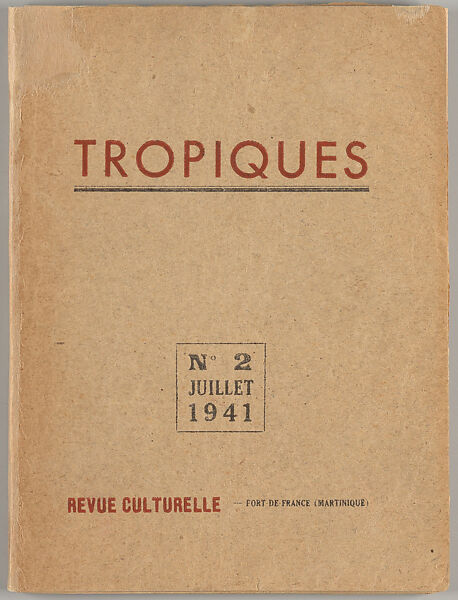
Tropiques No.2, from The Met Archive
Réné Ménil (1907–2004) was the most prominent vector of Marxism amongst his set of Martinican intellectuals, many of whom had studied in Paris and returned to the Antilles now swimming in Black internationalism, surrealist aesthetics, and eyes freshly sharpened to their colonial reality. Along with Aimé and Suzanne Césaire, he founded the journal Tropiques, which miraculously avoided Vichy censorship to become enormously influential on the subsequent generation of Martinicans, amongst them Frantz Fanon.
Marxism, Black internationalism, and surrealism did not automatically combine into a useful whole. At times, Ménil seems to believe that without A. Césaire––his extreme poetic talent, in full embrace of surrealism and its ability to mediate between extreme difference––the world would not have Négritude, that precursor to a fully decolonial consciousness that Fanon would later realize through action, in Algeria, and in theory, in The Wretched of the Earth.
This text, "Le passage de poésie à la philosophie," was originally published in Ménil's 1981 collection of essays Tracées. (As far as we know, this is its first time in English.) It has harsh words for Léopold Senghor and––as Ménil characterizes it––his essentialist vision of Blackness and Africanity, contrasting it with the Césairean version steeped in irony, ambiguity, and true ambivalence. I tend to agree with Ménil's analysis, though it seems reductive in places, but I'm pretty sure I don't get a vote (white).
Anyway, the point isn't to revive debate over a mostly dead term (however alive its descendants may be). The point is that it provides a compelling historical case to consider aesthetic experience as a preconscious form of cognition––as a fundamental mode of shepherding new consciousness out of history and into our mouths, so that it might finally find its highest expression in our hands.
As Glissant would have it: "one day, a commander of a liberation army told me: 'Wherever Black people are suffering, Négritude is completely necessary. But whenever they pick up a rifle, they no longer need it.'"
This––this can be the legacy of a poem!– J.A.B.
1.
Historically, Black poetry preceded the philosophy commonly known as Négritude.
A remarkable fact. We find that in its essentials, Black philosophy constitutes itself with a raw material that is primarily poetic, that the maxims, proverbs, metaphors and images––its hyperbolic amplifications, lyric cries, and ironic antiphrasis––are transferred from the domain of poetry and applied to that of philosophical exposition.
In 1948, Sartre's Black Orpheus inaugurates this method of ambiguity: it's with poems of the Anthology of the New Black and Malagasy Poetry that he edifies the first theorisation of Négritude. Senghor practices the same method and takes up the conceptions to which this method logically led (cf. interventions at the Congress of Black Writers and Artists, 1956 and 1959, and other discourse on the francophone world).
2.
If one compares the Notebook of a Return to the Native Land of Césaire (the official poet of Négritude, the principal evangelist, according to Sartre) and the philosophy of Senghor (the official philosopher of Négritude) which claims in various places and with insistence the Notebook, one finds it possible to measure in specific texts the margin which separates two languages, two orders of signification: the language and signification of poetics on one hand, the language and signification of philosophy on the other––all of which has been amalgamated and inadvertently confused under the same general denomination of Négritude until now.
(Though it's true that Négritude's poet, like the master Jacques de Molière, changes hats to act as theorist-philosopher without much fanfare.)
3.
So: let us read, uninterrupted, first the Notebook and then the philosophical exposés of Senghor.
One thing is striking: the difference of climate, of language, of thought.
In the Notebook, it's the lightness of spirit everywhere in the œuvre –– we want to say a vivacity and a speed of spirit which assure rapid shifts and reversals of thought and feeling.
By contrast, the spirit is of another kind in the philosophical texts of Senghor, an astonishing heaviness of conception.
More precisely, Senghor claims the Notebook to draw here and there from the Césairien poem this or that conception which serve him to define his Negro-African. But how do this deduction and geneology of concepts operate?
First of all, one notes a flattening of the poetic text which, by passing through Senghor, finds itself stripped of the humor and ambiguity constitutive of poetic sense and atmosphere.
Plenty of assertions which, in the Notebook, are ironic, find themselves with their sense inverted in the Senghorian doctrine because they're taken literally; they're "taken seriously."
Let's note in passing that this misunderstanding (misreading) by Senghor will be shared by The Society of the Friends of the Blacks and by plenty of Blacks in Africa and the Antilles.
Such a racist conception of the negro, which in the Notebook was borrowed from the white racist to be returned ironically, is found absurdly claimed in the Senghorian doctrine, affected by an inverted coefficient of positive value.
See here the negros described by Césaire in the Notebook, but described the way white racists love and want them to be:
Gaily obscene, so cuddlied by jazz for their excess of ennui
I know the boogie-woogie, baby; the lindy-hop and tap-dance
or for a real treat the mute of our lamentations wrapped up in wah-wah. Wait...
Everything's in order. I swallow my drumsticks. My dignity revels in their vomiting.
It happens, absurdly, that the inconsistency of the negro denounced here via tragic irony and antiphrasis ("everything's in order") will become in Senghor the very consistancy of the negro in Négritude.
The humor of the text has been ignored. And it's by the yardstick of this inconsistancy that Senghor obstinately intends to measure the value of the negro in the world. Believing he was subverting Descartes, he'd address the Europe of colonization and racism to say: "I feel, I dance, therefore I am!" This is either a stupid move or well-played –– depends on you –– since it's white racism that's formed this denigrated image of the negro uniquely devoted to techniques of frippery (see Gobineau). And on that front, this profession of faith: "Let Europe be the conductor, we negros, we'll content ourselves with the percussion (!)...It suffices us to mark imperiously the bass rhythm, the foot on the Earth!"
There's humor in Senghor here, but unfortunately only from an objective remove, without the advantage of self-awareness.
4.
In the Notebook antiphrasis and ellipsis are in constant service of poetic condensation. The poet ceaselessly distances himself from that which he is and from that which he says to produce a literary effect of derision.
The reader of Notebook quickly perceives, then, that sometimes the text's sense is to the letter itself, sometimes its sense is that letter's inversion.
This game within the poetic discourse of Notebook is explained by the very situation of which Césaire speaks. In Notebook, it is Césaire who speaks. But the constant return of Césaire to himself, to contest himself, to contest the colonized within himself, forces the emergence of an other-Césaire. Duality. But the principal interlocutor who's constantly interpellated (explicitly or implicity), and who the speaker constantly attempts to avenge himself against, is colonialism and white racism personified.
The poetic language of Notebook isn't simple, because the same language expresses three voices.
These three voices make themselves understood in a continuous discourse without explicit designation of which identity is speaking –– Césaire using the literary device of collage, pasting within a given line the words of another, without rendering them in quotes and without announcing the entry of this other.
Senghor is blind or wants to be blind (for the needs of his cause) to these "leaps" in the writing.
Unsensitive to the specific nature of poetic enunciation which is floating, polyvalent, in perpetual drift, in full-on fixed explosion, he doesn't perceive or intends to ignore an entire world of Césairien aversions that are only implied, but which are legible between or behind the written lines. For that it suffices to take account of the context of Notebook and its stylistic precedents. Without forgetting the context of Antillean culture reaching intellectuals around the '30s with modern modes of sensibility. (Note in Legitimate Defense a refusal of folklorization and of the heaviness of villagery.)
5.
In various university studies on Négritude, analysts agree to distinguish, at this time, two Négritudes––one of the Caribbean, that of Césaire, the other African, that of Senghor (cf. Négritude africaine, négritude caraïbe, Université Paris XIII).
It's the beginning of clarification.
To evoke here these two mentalities to explain the differences would be to inspire a "spontaneous naturalism," itself masking a form of racism within the Black world.
It's preferable to refer to the historical evolution (social-historical formation, formation of classes and elite intellectuals, social struggles and ideological content of these struggles, development of the sensibility––tastes and distastes ethical and aesthetic––as they function in the lifestyle and social movements, etc.) in the Antilles and Africa.
In sum: the rhetoric of Césaire and his thought, the regime and the register of his sensibility cannot define itself except in reference to an Antillean intellectual history––notably a linkage more marked in Africa with the critical spirit of the "Age of Enlightenment" (Voltaire, Diderot, Helvetius), with the ironic, rebellious, revolutionary French movement (during which decades the Antillean populations were impregnated with a rationalist, secular, atheist ideology––Schelcherism, the most advanced point of anticolonialism until just these recent years), with the progressivism of Jaurès and the thought of Marx without forgetting the western literary movements which have their immediate echo in the Antillean intelligentsia (Romanticism, Symbolism, Surrealism).
With Senghor, to the contrary, one notes: the marked influence of the "good missionary fathers" and the western ethnographers suggesting to him a backward idealism and the belief in a "prelogical negro mentality," an academicism of thought which never manages to unsettle folklorizing bizarrities, a naturalist metaphysics that fears movement and which never evokes history except to immobilize it in archaicisms and traditions, that is, when it is not simply located in "negro physiology."
Fear of movement to an extent that the problems of the Black world to be resolved today or tomorrow by means of effective social and human transformations, are sensed, according to Senghor, to have already been resolved in the Africa of the past (the famous African socialism of the primitive community) or in the "nature" and the "mentality" of negros (Surrealism would be a trait of the negro-african mentality).
6.
A passage of Notebook has been dedicated to Breton under the title "In the Guise of Literary Manifesto." In passing through Négritude, this passage served to establish, most seriously in the world, that negros are deprived of reason––conceptual, analytical, logical––but, by way of compensation, endowed with the "gift of emotion."
Let us quote:
Because we hate you, you and your reason, we claim for ourselves a precocious dementia, a flaming madness, a tenacious cannibalism.
...And you know the rest
That 2 and 2 makes 5
That the forest meows
That the tree shoots chestnuts of fire...etc.
This passage clearly functions as uppity charge against the civilization of colonialism and its "reason." And clearly that which is recused is "colonial rationality" and not the human rationality of negros.
Further, that which Négritude takes for anthropology (description of negro mentality) is, at the same time as an expression of political anger, an aesthetic, essentially––a poetic art of word and image.
7.
A prose translation of Notebook exists––or, let's say it's equivalent in prose, it's approximation, since strictly speaking it's impossible to translate poetry into prosaic language. Is it not poetry's explicit domain to say that which prose cannot say?
"the tree shoots chestnuts of fire..."
And this equivalency is not the Seghorienne prose of Négritude.
It's the prose of Césaire himself in the Discourse on Colonialism.
It's in the flaming pamphlet that we find the best of the philosophy and the concepts which undergird the Notebook––a responsible and rational vision of the destiny of the colonized in the modern world. The project of the negro without backwardness, without diminution, who takes on his shoulders the burden of all mankind––the burden of all man, of the entire human species.
8.
In the Notebook poetry makes naked Antillean realities, situated and dated in the sequence of historical events.
Let's quote a passage at random:
And I laugh and my old puerile imaginations
No, we've never been Amazons of the King of Dahomey, nor princes of Ghana with eight hundred camels, no doctor of Timbuktu, Askia the Great as king, nor architects of Djéné, nor Madhis, nor warriors. We don't feel the itch under our armpits of those who long ago held the lance... I want to confess that we've always been pitiful dishboys, shoeshiners of no stature, putting it mildly, conscientious sorcerers and the only indisputable record that we have broken is that of enduring the whip...
What's shown there is an avatar of Antillean colonial history. What's shown is a historically situated calamity, already overcome in anger and indignation, already surpassed in poetic vision.
In the Senghorienne expression of the presence of negros in the world, we assist with the transformation of colonial misery described above––a misery historical, thus transitory––into a misery congenital due to decisive traits of "psycho-physiology," otherwise known as the "nature" of negros (non-technicality, inability to tame nature, sensuality, surrender to the cosmos, etc.)
The historical sense of Notebook (the negro sometimes lazy and self-abandoning, sometimes rebellious and refusing), in passing through Négritude, becomes the absurd nonsense of a natural Black body.
9.
Césairean syntax, Senghorian syntax. Dynamics and statics of speech.
In the Notebook, Césaire makes words say what he wants them to say. Words are thus summoned in the Notebook to express the feeling and vision as the poetic work unfolds. And if such and such doesn't exist, the poet creates them!
Senghor, he, is respectful of words––which make him say what they want. He genuflects to etymologies and demands their counsel.
This retreat to the root of words, this scholastic terrorism of prefixes and suffixes is not undoubtedly the best method for inventing new sentiments and conceiving for the Black world a historically qualified future. To the contrary, it favors a retreat, confinement within archaicisms, the rebirth of traditional conformities which amaze the west in the same proportion as their bizarrities.
The Notebook, which sculpts within the Antillean imagination, wanted to be the historical contemporary of the modern negro.
The Senghorian Négritude will be the definitive mythological contemporary of the African past.
10.
It's not that Césaire, in the Notebook, doesn't make an important contribution to the elaboration of Négritude.
It's the how of the operation which is important to question.
One can note that the poetic density and the modulation of tone are not everywhere the same in the Notebook––that can be explained by the additions to the original text of 1939.
In any case, the last part of the poem (starting at page 77 in the Bordas Edition) conveys a message of a pedagogical and political character, the expression of which is close to prose. One might think that in this section the political conscience of the negros' situation in the world has taken precedence, "in revolutionary urgency," over the poetic consciousness and has (partially) cooled the aestheticizing reverie.
We have then a way of defining "negro-of-value" opposed to negro of the "old self-cadaverizing négritude."
It's this part of Notebook which constitutes the most substantial content of the mythology of Négritude in passing, as such, from the poem where it is situated, into the domain of philosophical prose. It's to be taken literally without regard to the inflections specific to the context, and with the coefficient of uncertainty that characterizes, as we have said, all text that presents as poetic.
A number of concepts then appear that we can formulate in neutral writing, which is to say in disentangling however possible from the metaphorical saturation of Notebook and the mythological redressing in which Senghor will cover them. In short, our task is to name simply these concepts. Let's cite:
–– communication with the universe, human participation in / of / the universe;–– non-science, technical non-domination of colonized negros;
–– grasping the essence of things (?);
–– arrogance of omniscient white conquerors and rehabilitation of those (the negros) who could invent nothing under the conditions of colonialism
–– will and assurance of regeneration, liberation, and flourishing of the Black world
–– universal love of humankind and antiracism (humanism) linked to the need to "cultivate" the Black race.
And now what does the transposition of these concepts yield to a philosophical systematization that forms itself later on?
Extracting a phrase from a poem to introduce it verbatim, as does Senghor (and, it must be said, Césaire himself when expounding the theses of Négritude), in an exposition philosophical and political, is not without its problems.
Sartre, being a philosopher, clearly has misgivings in his theoretical work, of which he eventually unburdens himself by making Négritude a phantom, after having pained himself to give it substance with the material of negro poems: Négritude, he concludes, is the weak point in a dialectical progression. It is "for self-destruction" in the humanism of the "society without races."
Senghor, who doesn't adhere to any rigor in the production of his concepts since his "truths" are "intuitive"––insists, he does, on repeating that his conception of the negro, Négritude, is eternal like God the Father, which proves the mythological character of his doctrine.
To constitute these atemporal concepts, he subjects the utterances of Notebook to a treatment not uncomparable to the Pharaonic embalming of Egypt. The sense which, in the poetic writing, was mobile, floating, equivocal, polyvalent, evasive like it must be in poetry, brief, the meanings suspended will be brusquely petrified in mid-flight to fall back into heavy axioms. The richness of potential connotations evaporate to make space for depressing impoverished concepts: "the negro is emotion," "the negro is rhythm..."
The Notebook had said:
Eia for those who've invented nothing
for those who've never nothing explored
for those who've tamed nothing
Eia for joy
Eia for love
Eia for the dolor at the tit of reincarnated tears
etc., etc.
Starting with this text to conclude––as Senghor does (2nd Congress of Black Writers and Artists)––with the congenital non-technicality of the negro, to proclaim the positive value of this non-technicality, and to affirm, ultimately, the radical opposition between the mental faculty of Blacks (emotion) and Whites (reason)––this is born from misunderstanding.
For no accurate analysis will discover in this passage a definition and a description of the negro mentality excluding aptitude for logic and active practice of technique. No accurate analysis will see non-technicality erected as value and proposed as ideal of life. Completely to the contrary, in establishing the poetic sense of the text, this analysis places us in front of historical fact, not reclaimed value. It reveals that this avatar of history of black colonized peoples is accepted in a conscience that self-authenticates, but that the avatar is accepted in the form of a challenge, in the end, that the irony and the bitterness that undergird the discourse signify that the lack (the non-technicality) which is acknowledged is already surpassed in the bounty of a strong-willed historical project.
11.
A negro appears in the Notebook, whom the reader knows to be constituted by means of literary amplification and poetic hyperbole.
But this negro who "abandons himself, seized, by the essence of everything, ignorant of surfaces but seized by the movement of everything"––who is he?
It is without doubt, within the negro, man in his aesthetic temperament. Homo estheticus: the man white or black seized by emotion and softly drifting through imaginary worlds. Man in aesthetic experience.
Négritude is an aesthetic that mistakes its identity and which takes itself for an anthropology––for the realistic truth of a mentality.
This, which is not surprising, conceived as it was by three poets––Césaire, Damas, and Senghor himself.
12.
A poem such as that of Notebook which expresses a historical vision of the drama of negros in the world and which commands a vigorous creative imagination ultimately contains more objective truth than philosophical prose which logically fabulates by stringing together dead concepts.
The terroristic dogmatism of Senghorian Négritude––peremptory affirmations, rigid axioms––must not create illusions. Dogmatism's function is to conceal that which must be debated and to offer as solution the problem itself. Négritude will insistently pose problems that await no solution because they are––on the margin of real problems––problems of illusion. Asking ourselves, after the manner of Senghor, if the negro is emotion is, as in the fable, following the rat-whistler out of the city.
The fact is that Négritude is a mythology which, as such, must be read in imagery and in its mythological functioning. The negro of Senghor must be read not so much as in the verbal discourse as in the visual register of advertisement's metaphors.